How to Review a Local-First Utility Without Mistaking Marketing for Evidence
A transparent review framework for privacy claims, core workflows, failure states, and support readiness.
RAYMSM Systems accelerates industrial R&D by vertically integrating custom laboratory instrumentation with intelligent automation frameworks. We engineer custom data acquisition hardware along with software, specialized material characterization systems, and edge-AI software solutions to transform complex physical testing into real-time, actionable insights.

An integrated mechatronics-software pipeline bridging physical materials synthesis with cognitive automation systems.

Eliminate friction-heavy manual operations with advanced AI cognitive architectures automated across the entire laboratory lifecycle. Skip archaic manual data logging entirely in favor of actively optimized workflows, structured instrument parsing, and closed-loop robotic feedback loops that adapt to real-time physical phenomena.

Harness multiple physical material properties simultaneously. We build advanced architectures driven by edge nodes, custom high-resolution sensor arrays, and unified cross-platform (Android, Linux, PWAs) ecosystems. This ensures synchronous characterization streams, eliminating calibration errors from split testing.

Transform raw instrumental outputs. We build automated data-handling and processing pipelines for complex lab instruments (XRD, TEM, HPLC) and multi-channel logging systems. Our software bridges analog instrumentation streams into developer-class API access, enabling instant statistical analysis.
Modern laboratories remain constrained by archaic workflows and closed physical silos. We tackle these limitations at the source.
Legacy laboratory hardware operates in isolated silos. Data generated on one characterization station cannot easily interface with downstream analysis tools, requiring manual transport and formatting.
Researchers spend up to 40% of their bench time hand-recording measurement values, parameter variations, and climate conditions, introducing human transcription errors.
R&D processes are fractured between synthesis, testing, and modeling. Without a unified mechatronics data pipeline, active loop optimization is slow and labor-intensive.
Small variations in experimental setups go undocumented, leading to a replication crisis. Without automated environmental and raw waveform logging, duplicating results is mathematically impossible.
Scientific instrumentation suites use closed proprietary ecosystems that impose steep licensing fees, while providing zero APIs or custom script endpoints for academic customization.
We bridge the gap between physics-based laboratory hardware and cloud-edge data architectures.
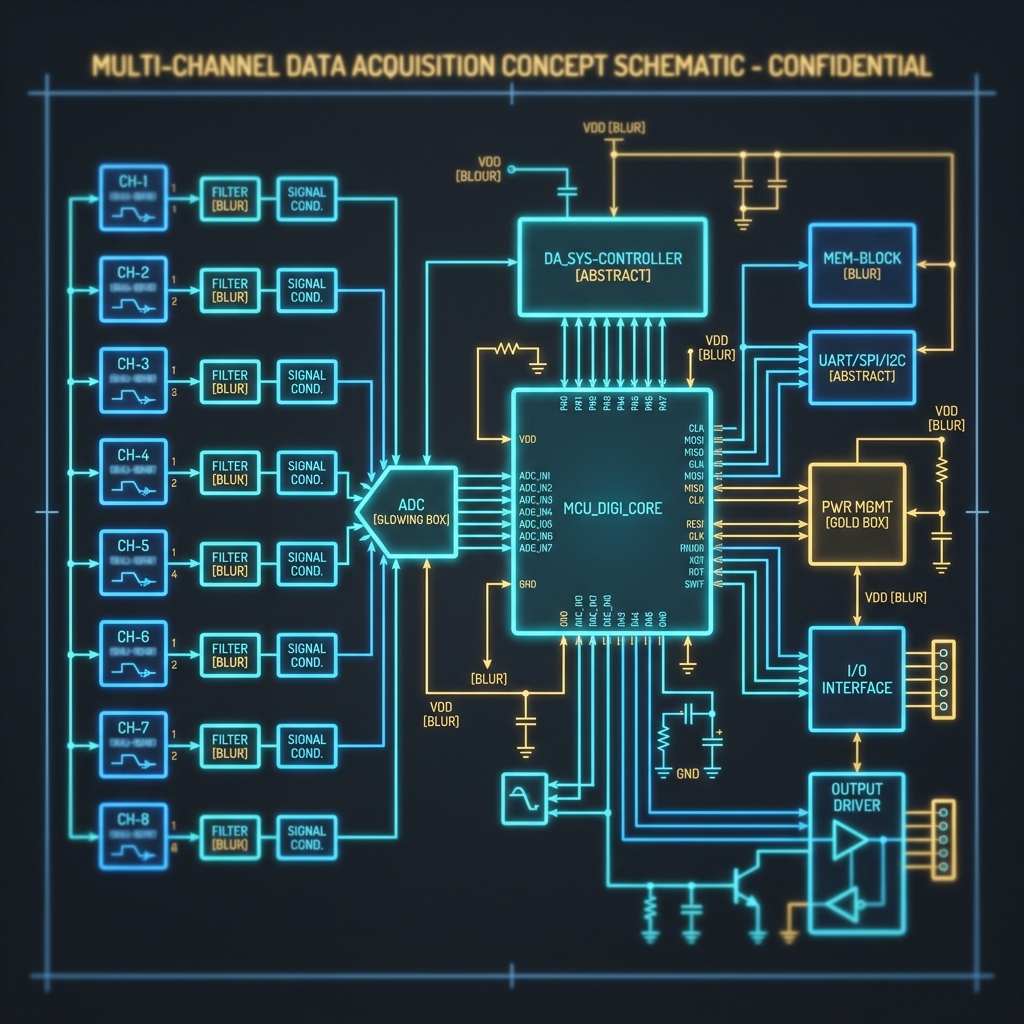
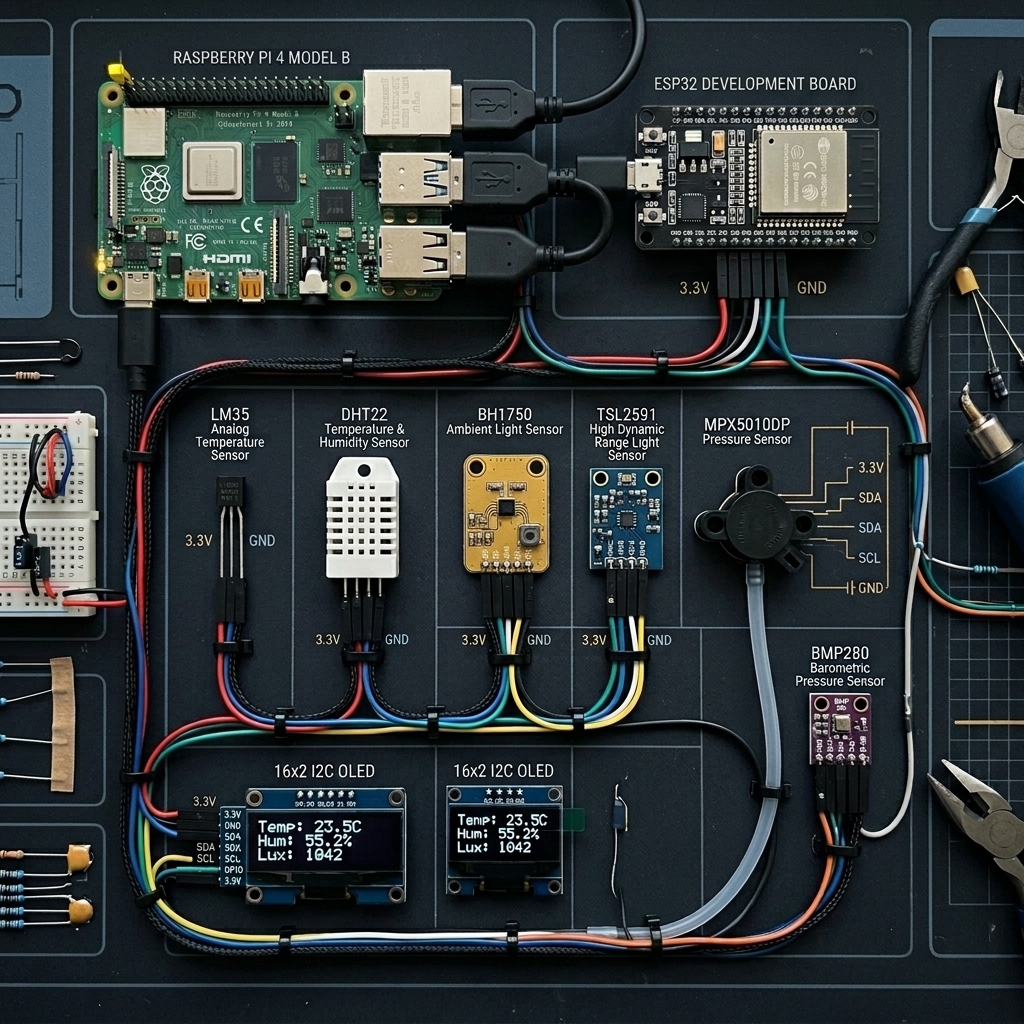
Low-latency custom firmware deployments leveraging ESP32 and Raspberry Pi microcomputers integrated with multi-channel hardware DAQ architectures. Engineered for high-speed sensor polling, analog-to-digital filtering, and real-time serial communication protocols.

ESP32 RTOS / SPI / I2C / 24-bit ADC / Hardware InterruptsLocal, containerized large language models (LLMs) and cognitive agent networks optimized for experiment design, rapid literature synthesis, and multi-stream data interpretation. Integrated with visual workflow orchestrators like n8n.

Ollama / Llama 3 / RAG Pipelines / n8n / Local AI ContainersResponsive visualization dashboards and automated report generation pipelines. Runs as a progressive web app (PWA) or desktop wrapper to transform raw streams into clean interactive charts, heatmaps, and publication-ready SVG figures.

Next.js / TypeScript / Tailwind CSS / WebSockets / ChartJSUnified machine-to-machine (M2M) communication layers converting legacy isolated hardware arrays into interconnected analytical networks. Enables remote monitoring, automated parameter sweeping, and instant error notification pipelines.

MQTT / gRPC / Docker / Node-RED / Secure Local GatewaysIntegrating physical materials science with intelligence layers to offer end-to-end laboratory automation and edge telemetry solutions.
Designing, modeling, and fabricating low-cost, high-precision mechatronics rigs (like Laser Flash Analysis and 3-omega setups). We replace slow, manual laboratory operations with fully automated thermal and electronic diagnostics.
Structured engineering contracts and custom hardware design commissions for academic and industrial research labs.
Deploying local AI models (U-Net segmentation, raw telemetry parsing) and orchestrating containerized workflow nodes (Ollama, n8n, custom Python wrappers) directly at the laboratory edge to parse data streams into clean developer APIs.
Commercial software licensing, bespoke data piping, and middleware integration services for sensor array networks.
Developing robust edge firmware (ESP32/FreeRTOS) and serial gateways (Raspberry Pi/Python) paired with native high-performance mobile telemetry canvases (SerialDAQ) for real-time visualization and log export.
Licensing pre-compiled firmware stacks and deploying tailored structural engineering companions (Civil Suite).
Releasing foundational tools and libraries as open-source repositories to support global scientific research (XRD plotting, alloy prediction), while providing enterprise support and customization for manufacturing partners.
Commercial dual-licensing, dedicated service level agreements (SLAs), and custom integrations under strict NDA parameters.
An overview of ongoing engineering developments bridging solid state chemistry and digital automation.
Development of a low-cost, high-precision thermal conductivity characterization system integrating Laser Flash Analysis (LFA) and the electro-thermal 3-omega method. Backed by the IIC Seed Grant Support 2025-26 to democratize access to advanced thermal properties testing.
Building an agentic RAG infrastructure that digests material datasheets, reads real-time sensor streams via local APIs, and coordinates complex experiment logs. Helps design parameter grids for new material synthesis runs.
Custom instrumentation nodes equipped with isolated high-resolution analog front-ends (AFEs) for extreme precision voltage, current, and temperature logging, designed to withstand electromagnetic noise inside furnaces.
Developing lightweight open-source wrappers for serial-based lab instruments (furnaces, chillers, potentiostats). Exposes simple Python APIs and REST endpoints to run automated thermal cycles.
Cloud-edge processing layer providing microservices to parse raw characterization binary file formats, automate peak-fitting math, and output publication-ready structural plots.
We stand at the intersection of cheap high-performance mechatronics, local edge reasoning, and a critical demand for data integrity.
AI is moving past text generation into physical design. Small, local, highly specialized LLMs can now plan multi-step chemical reactions, predict thermodynamic properties, and generate hardware code, acting as automated R&D reasoning engines.
Custom instrument fabrication is no longer gated by massive industrial manufacturers. Standardized CAD schemas, low-cost precision machining, and open-source mechatronics allow researchers to assemble state-of-the-art testing stations at 10% of traditional costs.
Low-cost microcomputers and microcontrollers (ESP32, Raspberry Pi) are now powerful enough to run local filtering, coordinate complex sensor arrays, and interface directly with edge neural networks without network latency.
Up to 70% of researchers fail to reproduce published laboratory results due to unrecorded variables. There is an urgent, systemic push for automated, tamper-proof logging of atmospheric, voltage, and temporal waveforms to restore absolute reproducibility.
The next paradigm of materials discovery is self-driving labs. Achieving this requires linking hardware automation with cognitive model logic, closing the loop so software can write, run, and learn from physical experiments without human intervention.
Practical materials-science articles, mechatronics instrumentation guides, and reproducible research notes compiled under our active systems research.
A transparent review framework for privacy claims, core workflows, failure states, and support readiness.
Use local AI as a reading assistant without treating generated summaries as evidence.
Design Android utilities around a clear privacy boundary, resilient states, and a support-ready release path.
We leverage robust open-source programming frameworks, custom low-level electronics, and containerized AI edge architectures.
Custom firmware written in C++ using ESP-IDF or RTOS cores. Handles low-level multi-channel ADC polling, thermocouple filtering, and local PWM control loops.
Edge-gateways deployed on Linux. Coordinates communication arrays, hosts local server wrappers, handles data buffers, and routes to secure databases.
Our primary language for materials modeling, peak-fitting calculations, instrumental scripting, and serial drivers (PySerial, NumPy, SciPy, Pandas).
Ollama-hosted LLMs integrated with LangChain or n8n workflows. Automates instrumentation report parsing and translates raw text commands into physical parameter matrices.
Containerized analytics nodes running directly on laboratory routers, guaranteeing total local sovereignty, low latency, and offline operational redundancy.
Secure telemetry pipelines built on lightweight MQTT brokers, WebSockets, and Cloudflare Page deployments for analytics visualizations.
Automated analysis pipelines transforming raw measurements into structured JSON, publication-ready SVG figures, and calibration logs.
Custom digital drivers interfacing with legacy scientific instrumentation via Modbus, RS232, RS485, and TCP/IP interfaces.
Contact our engineering and administrative pipelines directly. We partner with academic laboratories, research institutes, and materials manufacturers to construct custom instrumentation mechatronics and AI workflows.